


India to Control Future Currency: Blueprint for India Becoming a Superpower Hidden in Rajasthan’s Sand Grains
Date: February 1, 2026. When Finance Minister Nirmala Sitharaman was opening the budget box in Parliament, the eyes of the whole world were glued to TV screens. But this budget was not just an account of income and expenditure. It was a ‘War Declaration’ of India, the echo of which has been heard from Beijing to Washington. Calling it just an economic document would be the biggest foolishness. It would be more appropriate to call it India’s geopolitical surgical strike.
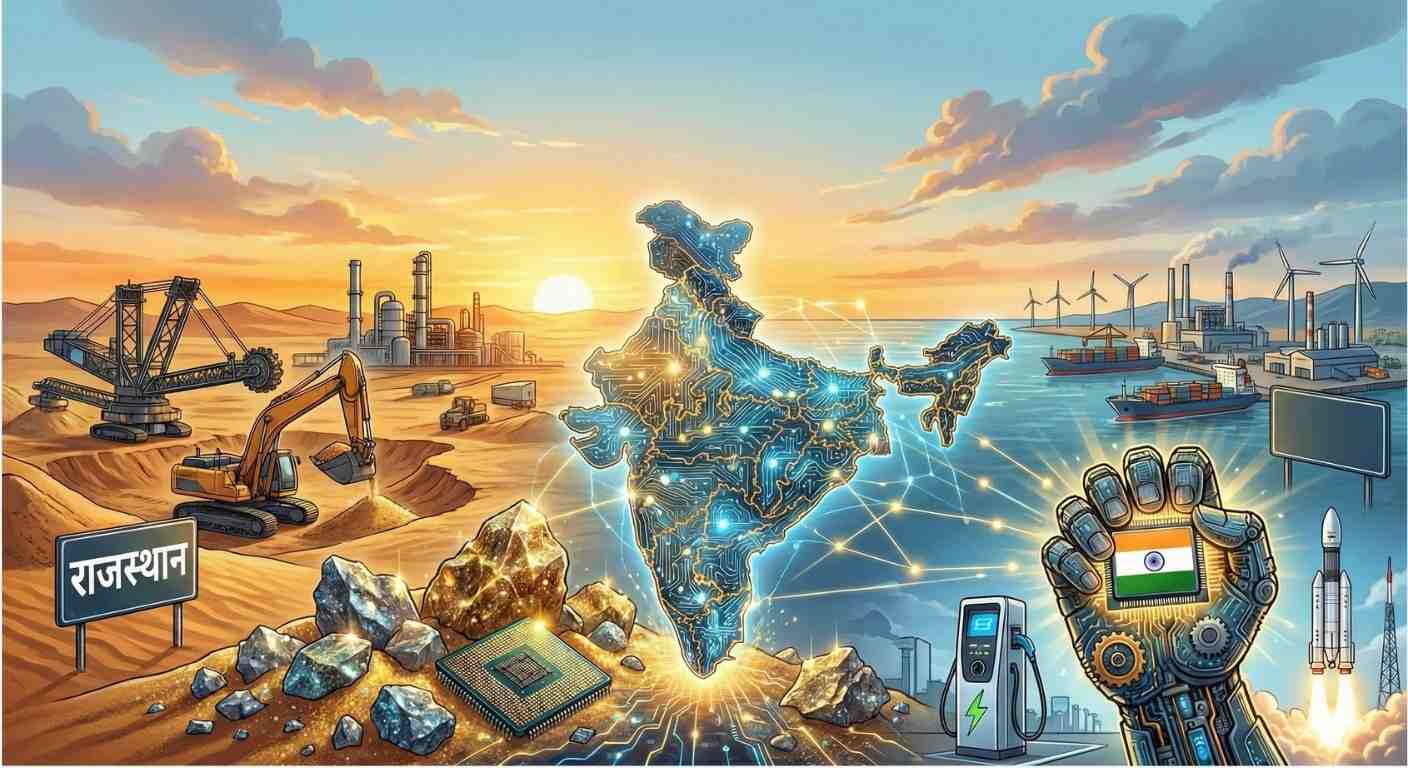
In the era we live in today, oil has become old news. “Data is the new oil”, this too has become a cliché dialogue. The real game is now of Critical Minerals, Rare Earth Elements, and Semiconductors. What you and I consider ordinary stone or sand is actually the gold of the 21st century. And in this budget of 2026, the Modi government has made it clear that India will no longer be a buyer of this gold, but a merchant.
The matter is quite complex. Let’s go into a bit of a flashback to understand this. Whether it is the smartphone in our hand today, the electric car running on the road, our missiles deployed at the border, the guidance system of a fighter jet, or the magnets of a wind turbine—Rare Earth Elements are used in all of them. And the bitter truth is that for the last three decades, China had made this market its fiefdom. China controls 80 to 90 percent of the processing. It can choke the world by squeezing the supply chain whenever it wants. But on February 1, 2026, India has said, “Enough, no more!” The biggest thing that came out in the budget is the Dedicated Rare Earth Corridor and Semiconductor Mission 2.0. This is not just empty talk. The government has opened the mouth of its coffers so that we can be free from China’s slavery. The government has slashed custom duties and torn up the rules for domestic mining to make it so easy that a line of investors will now form.
Now let’s talk about the biggest player in this game, who was behind the scenes until now, that is our Rajasthan. The land of warriors, Rajasthan! Until now, we have known Rajasthan only for tourism, forts, and deserts. But Budget 2026 has turned the page of Rajasthan’s destiny. The evidence found by scientists and geologists is mind-blowing. The Geological Survey of India (GSI) has clarified that about 1.29 million tonnes of Hard Rock Rare Earth is present in Rajasthan and Gujarat.
Such rare earths are hidden in the rocks here, which are found in very few places in the world. The rare earth found in coastal areas is in sand, but in Rajasthan, it is in solid rocks. A massive exemption has been given in the budget for this advanced technology and exploration. This means big refineries will now stand in Nagaur and surrounding areas. In the Degana area of Nagaur, signs of Lithium and other critical minerals have already been found. Lithium means the thing without which your electric vehicle cannot move an inch. Rajasthan has become a ‘Multi-Tasker’. In the budget, the government has completely waived custom duty on those machines and capital goods which are useful in making Lithium-ion batteries. Since Rajasthan is already the King of Solar Energy, battery manufacturing factories will also be set up there now. Meaning electricity will be generated there and the battery to store it too. Imagine what a flood of jobs is going to come in Rajasthan now.
Now let’s turn our eyes to the rest of the country, because Rajasthan cannot fight this battle alone. This is Team India’s game. The budget has turned the states of South and East India – Kerala, Tamil Nadu, Andhra Pradesh, and Odisha – into a strategic shield. The government has announced the creation of Dedicated Rare Earth Corridors in these four states. This is not a road corridor; it is a complete industrial cluster. Kerala and Tamil Nadu have a treasure trove of Monazite sand on the coast. It is packed with Thorium and Rare Earths. Until now, we used to send raw sand or slightly processed goods outside. But not anymore. A Rare Earth Permanent Magnet Scheme (REPM) of Rs 7,280 crore has been green-lit in the budget. Its purpose is to sell finished products, not raw soil. The government has decided to make Tamil Nadu and Andhra Pradesh EV and Magnet Hubs. The permanent magnets made from rare earth are the heart of an electric motor. Until now, we used to import these magnets from China. The budget plan is that these magnets should be made in Tamil Nadu’s factories and fitted into electric cars being built right next door. Such supply chain integration is enough to blow away China’s sleep. On the other side, Odisha and Andhra Pradesh have also got a big role on the eastern coast. Indian Rare Earths Limited (IREL) is already present in Odisha, but now a complete ecosystem will be built there. Refineries to purify minerals necessary for defense electronics will be set up in the coastal areas of Visakhapatnam and Odisha.
And Gujarat is going to become a hub of semiconductors. In the budget, the Finance Minister has announced the India Semiconductor Mission 2.0 (ISM 2.0). In the first mission, we showed the world that we can set up fabs, now in Mission 2.0, we will show that we can invent technology too. Initial Rs 1,000 crore has been kept aside separately for ISM 2.0, but the real game is the thinking behind it. The government is no longer happy just with assembly. Now we will produce chip-making machines, those ultra-pure gases, and those chemicals in India itself. And its epicenter is—Gujarat. Micron’s plant in Sanand is going to start full production by the end of February 2026. This is India’s first major commercial chip packaging plant. The Tata plant coming up in Dholera is a game-changer anyway. Budget 2026 has worked to add fuel to this fire. The budget for the Electronics Components Manufacturing Scheme (ECMS) has been increased to Rs 40,000 crore. This means every small and big part of mobile and laptops will now be Made in India.
Now let’s come to the real point, why is the Modi government becoming so aggressive? So for the Modi government, this is purely a matter of national security. The government’s thinking is crystal clear—“Strategic Autonomy”. Meaning, living on your own terms. In today’s era, if you do not have semiconductors and rare earth, then your modern army is crippled. Our Tejas fighter jets, BrahMos missiles, nuclear submarines, satellites, and drones, all use high-grade chips and rare earth magnets. Imagine, in the middle of a war, if the enemy country refuses to give us spare parts or chips, will we hang up our guns? Absolutely not!
This masterstroke of Budget 2026 is the biggest step towards making India self-reliant. The government is building a parallel supply chain. The world calls this “China Plus One” strategy, but India is playing it as the India First strategy. The government’s vision is very long-term. By 2047, when India turns 100, we will be a developed India. At that time, the world will be running on green energy, not oil. And green energy means – batteries, solar panels, and windmills. For all these, we need Lithium, Cobalt, Nickel, and Rare Earth. The seeds Modi government is sowing today, future generations will eat its fruit. This is a preparation to take control of the future currency. Apart from this, it is also another name for economic freedom. We import oil and electronics worth billions of dollars every year. If we start making chips and batteries in our own country, our import bill will crash down. The Rupee will strengthen, and our currency will stand tall against the Dollar.
The sum and substance is that Budget 2026 was not an ordinary budget. It is a very big, heavy, and bold step taken towards making India a superpower. From the deserts of Rajasthan to the beaches of Kerala, the sound of a new revolution is being heard. The government has done its job – shown the way, given the money, and simplified the rules. Now it is the turn of our industry and our youth to grab this opportunity. Remember, the world is changing. The country that secures its supply chain today will rule the world tomorrow. India has buckled up. We have entered the field to challenge China. This is a war of minerals, and this time India is playing to win.
Bhagwati Baldwa
Author
Industrialist, Founder of the country’s first Ayurvedic Unicorn company Ixoreal Biomed and Shri Kartikeya Pharma.